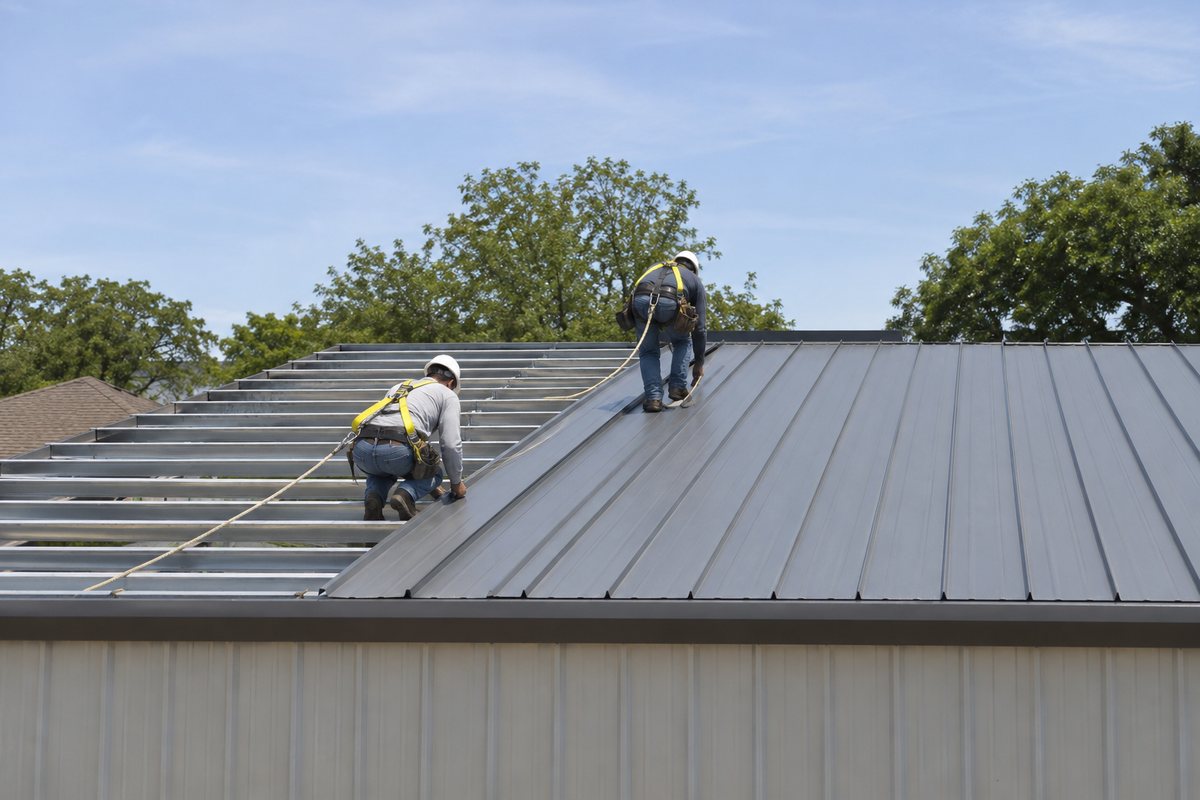
The short answer
Through-fastened panels are screwed straight through the face of the panel into the deck or framing. They cost less and install faster. Standing seam panels hide their fasteners under a raised seam. They cost more, look cleaner and need less upkeep over the life of the roof.
Side-by-side
| Through-fastened | Standing seam | |
|---|---|---|
| Fasteners | Exposed screws with rubber washers | Hidden clips or a concealed flange |
| Look | Ribbed panels, visible screw lines | Clean, flat panels with tall seams |
| Typical gauges | 29, 26, 24 | 26, 24, 22 |
| Typical minimum pitch | 1:12 to 3:12 by profile | ¼:12 to 3:12 by system |
| Thermal movement | Limited; screws hold the panel fixed | Clips allow the panel to expand and contract |
| Maintenance | Check and replace worn screws every 10 to 20 years | Little routine maintenance |
| Material cost | Lower | Higher |
| Labor | Faster, simpler | Slower; mechanical seam needs a seamer |
| Common uses | Barns, shops, metal buildings, budget homes | Architectural homes, commercial roofs, low slopes |
Typical ranges; exact figures vary by product.
When through-fastened makes sense
- Agricultural buildings, shops, garages and sheds
- Metal buildings over open purlins
- Re-roofs on a budget
- Walls and siding, where exposed screws matter less
When standing seam makes sense
- Homes where appearance matters
- Low-slope roofs, where the raised seam keeps water out
- Long panel runs, where thermal movement adds up
- Owners who want a roof with less maintenance
- Roofs that will get snow guards or solar panels, which can clamp to the seams without holes
Cost over the life of the roof
Through-fastened roofs cost less up front. Over 40 years or more, they need periodic screw checks and replacements, which add labor. Standing seam costs more up front but has fewer leak points and less upkeep. For a building you'll keep a long time, compare the total cost, not just the first price.