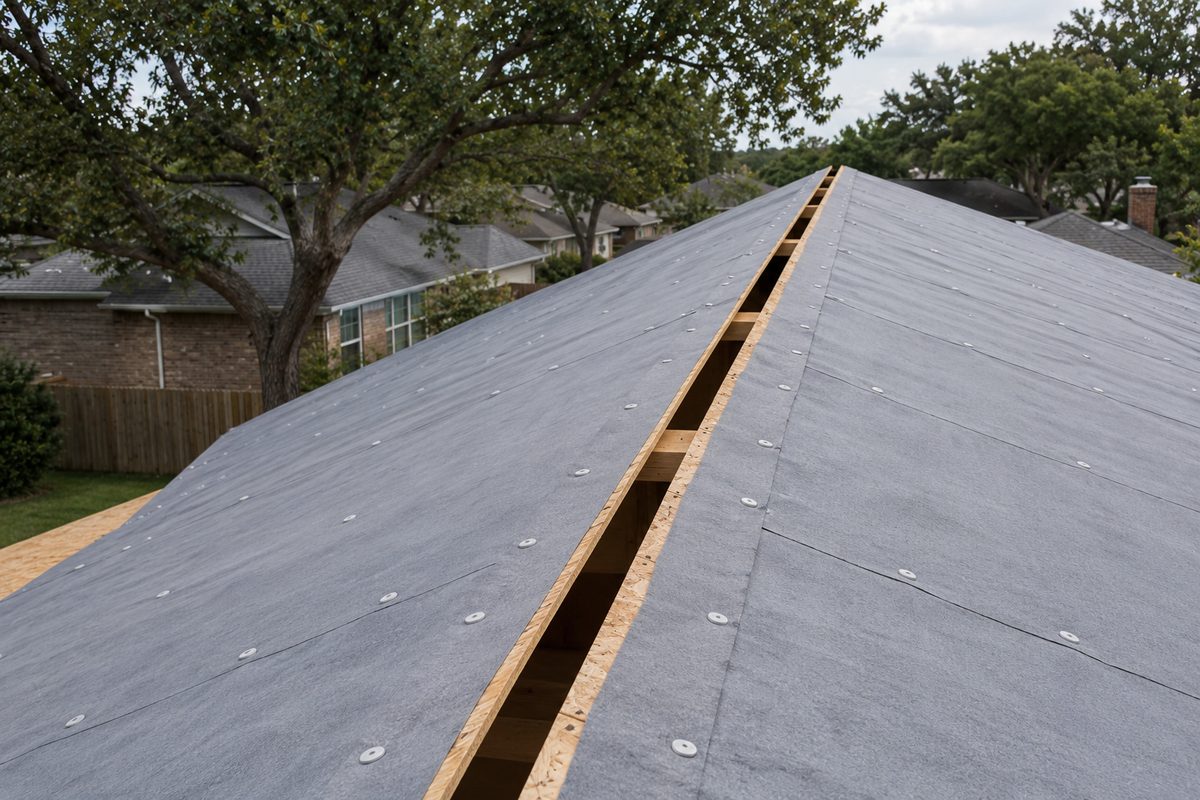
Underlayment types
| Type | What it is | Typical roll coverage (SQ) | Temperature rating | Common uses |
|---|---|---|---|---|
| Felt (asphalt-saturated) | Organic or fiberglass mat soaked in asphalt; #15 and #30 weights | 2 to 4 SQ | Standard | Budget shingle roofs, under some tile |
| Synthetic | Woven or spun polymer sheet | 10 SQ | Standard to 240°F+ | Most shingle and metal roofs today |
| High-temperature synthetic | Synthetic rated for heat under metal | 10 SQ | 240°F to 260°F+ | Standing seam and other metal roofs |
| Self-adhered | Rubberized asphalt or butyl sheet with a peel-off back | 1 to 2 SQ | Standard or high-temp | Eaves, valleys, penetrations, low slopes, full coverage in high-wind areas |
| Tile underlayment | Heavy-duty felt, mineral-surfaced or self-adhered sheets made for tile | Varies | Standard to high-temp | Clay and concrete tile roofs |
A square (SQ) is 100 sq ft. Coverage, weights and ratings vary by manufacturer. Your quote lists the exact specs.
Felt. The traditional underlayment. It is low in cost but heavier, tears more easily and can wrinkle when wet.
Synthetic. Lighter, stronger and more tear-resistant than felt, with more coverage per roll. It is the standard choice for most new roofs.
High-temperature synthetic. Metal roofs can get very hot. High-temp underlayment is rated to handle that heat without breaking down, and many metal panel makers require it.
Self-adhered. Sticks directly to the deck and seals around nails and screws. It is used at eaves, in valleys and around chimneys, skylights and vents, and as full coverage on low slopes or in hurricane zones where code calls for a sealed deck.
Ventilation
A well-ventilated attic pulls cool air in low and lets hot, moist air out high. Without it, heat builds up, shingles and underlayment age faster, and moisture can cause mold and rot.
| Product | Type | What it does |
|---|---|---|
| Ridge vent | Exhaust | Runs along the ridge under the cap; the most even exhaust |
| Box (static) vent | Exhaust | Individual vents near the ridge |
| Turbine vent | Exhaust | Wind-driven spinning vent |
| Power and solar attic fans | Exhaust | Fans that pull air out of the attic |
| Gable vent | Exhaust or intake | Louvered vents in the gable walls |
| Soffit vent | Intake | Vented soffit or individual vents under the eaves |
| Edge (drip edge) intake vent | Intake | Intake at the roof edge where there's no soffit |
Balance matters. Most codes call for about 1 sq ft of net free area (NFA) for every 150 sq ft of attic floor, or 1 per 300 sq ft with balanced intake and exhaust. Exhaust should not be larger than intake. Mixing different exhaust types on the same roof can short-circuit airflow, so most experts recommend one exhaust type per attic.
Always check local code for ventilation requirements.
Ventilation for metal roofs
Metal roofs use vented ridge closures or profiled foam closures with a breathable vent strip under the ridge cap. On roofs over battens or purlins, the airspace under the panels adds extra airflow and helps reduce heat.
Installation basics
- Install underlayment from the eave up, with upper rows lapped over lower rows.
- Follow the manufacturer's lap widths and fastener spacing; synthetic underlayment usually uses cap nails or cap staples.
- Put self-adhered membrane down first at eaves, valleys and around penetrations, then lap the field underlayment over it.
- Don't leave synthetic underlayment exposed to the sun longer than the manufacturer allows.
- Size intake and exhaust vents before ordering.
Always follow the manufacturer's instructions and local code.
What to include in your quote request
- Roof type (metal, tile, stone-coated or shingle) and size in squares
- Underlayment type, or let us suggest one for the roof
- Eave, valley and penetration lengths for self-adhered membrane
- Ridge length and attic size for ventilation
- Job location
Related products
Common questions
Do I need high-temp underlayment under metal?
Most metal roof manufacturers require or recommend it, especially on dark colors and in hot climates.
Is synthetic better than felt?
For most roofs, yes. It is lighter, stronger and covers more per roll. Felt still has uses under some tile and on budget jobs.
Where does self-adhered membrane go?
At minimum, usually in valleys and around penetrations. Many codes also require it at the eaves in cold climates, and some areas require full coverage.
How much ventilation do I need?
It depends on attic size and local code. A common starting point is 1 sq ft of net free area per 150 to 300 sq ft of attic floor, split between intake and exhaust.
Can I have too much ventilation?
Exhaust without enough intake can pull conditioned air from the house. Balance intake and exhaust.