Framing members
| Member | Shape | Typical depths | Typical gauges | Common uses |
|---|---|---|---|---|
| C-purlin / C-girt | C-shaped channel with lips | 4″ to 12″ | 16, 14, 12 | Roof purlins, wall girts, headers, door framing |
| Z-purlin / Z-girt | Z-shaped section | 6″ to 12″ | 16, 14, 12 | Long roof runs; Z's can overlap at supports for strength |
| Hat channel | Hat-shaped furring strip | 7/8″ to 1½″ | 26 to 20 | Purlins for metal roofs over wood, furring for walls and ceilings |
| Eave strut | Sloped C-shaped member | 6″ to 10″ | 14, 12 | Eaves of metal buildings, where roof meets wall |
| Square and rectangular tube | Hollow tube | 2″ to 4″ and up | 14, 12, 11 | Carports, frames, posts, gates, trusses |
| Studs and track | C-stud with U-shaped track | 2½″ to 6″ | 25 to 16 | Interior walls, light structural walls, soffits |
| Angle and flat bar | L-shape or flat strip | Various | Various | Bracing, clips, trim supports |
| Structural beams and columns | Wide-flange (I-shaped) and tube steel | Per engineering | Per engineering | Main frames of larger metal buildings |
Sizes, gauges, coatings and availability vary by manufacturer and mill. Your quote lists the exact specs.
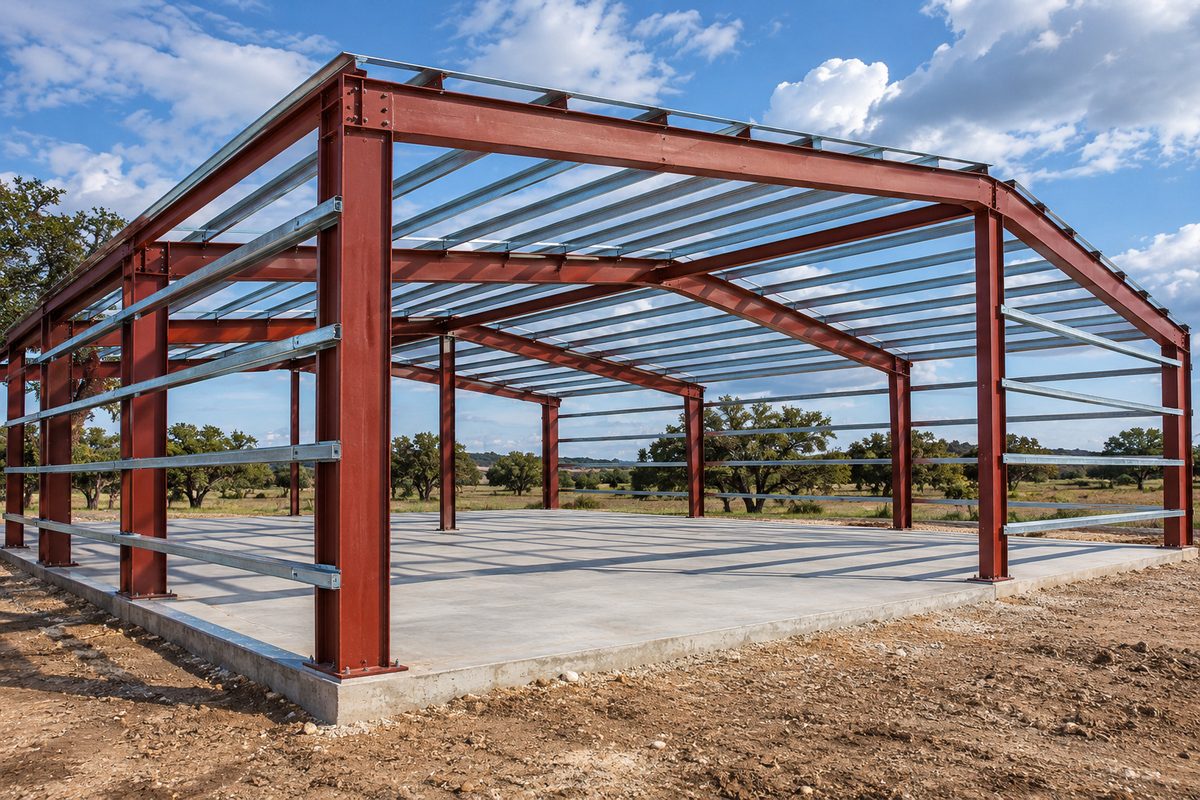
C-purlins and girts. The workhorse of light steel buildings. Used as roof purlins, wall girts and framing around doors and windows.
Z-purlins and girts. The Z shape lets one purlin lap over the next at each support. That overlap makes the run stronger and allows longer spans, which is why Z's are common on larger metal buildings.
Hat channel. A light furring strip that creates a flat, even surface. It is often used to put a metal roof over an existing roof, to make an air gap under panels, or to fur out walls and ceilings.
Tubing. Square and rectangular tube steel is strong in every direction, so it is common for carport frames, posts, trusses and gates.
Studs and track. Light-gauge steel framing for walls and ceilings, used in commercial interiors and some homes.
Gauge and thickness
| Gauge | Typical thickness | Typical use |
|---|---|---|
| 20 | about 0.036″ | Light studs, hat channel |
| 16 | about 0.060″ | Light purlins and girts, structural studs |
| 14 | about 0.075″ | Purlins, girts, carport framing |
| 12 | about 0.105″ | Heavy purlins, eave struts, longer spans |
Lower gauge numbers mean thicker steel. Actual thickness varies slightly by manufacturer.
Coatings and finishes
- Galvanized: zinc-coated steel, usually G60 or G90 (G90 has more zinc and better corrosion resistance). Common for purlins, girts, studs and tube.
- Primed (red oxide or gray): a shop primer for steel that will be painted or kept indoors.
- Painted: some framing comes pre-painted to match building colors.
Engineering and code
Purlin size, gauge and spacing depend on the span, roof load, wind speed, snow load and local code. For buildings that need a permit, framing should be sized by a licensed engineer or taken from stamped building plans. We supply the members your plans call for; send the plans or a material list with your quote request.
Installation basics
- Steel framing is fastened with self-drilling screws, bolts or welds, depending on the member and the design.
- Follow the plans for lap length, bracing and bridging. Purlins and girts need bracing to reach their full strength.
- Cut ends of galvanized steel can be touched up with zinc-rich paint.
What to include in your quote request
- Member type, depth, flange size and gauge
- Lengths and quantities, or plans or a material list
- Coating: galvanized, primed or painted
- Clips, connectors and fasteners needed
- Job location
Related products
Common questions
C or Z purlins: which do I need?
Your plans should say. In general, C's suit shorter, single spans and framed openings, and Z's suit longer continuous runs where they can lap at supports.
Can I order exact lengths?
Framing members can be ordered in the lengths your project needs. List the lengths in your quote request.
Is steel framing more expensive than wood?
It depends on the project and market prices. Steel often costs more up front but lasts longer with less upkeep, and it doesn't burn, rot or attract termites.
Can I use hat channel to put a metal roof over shingles?
In many cases, yes. Hat channel or wood purlins create a flat base and an air gap. Check local code and the panel manufacturer's instructions first.
Do you supply complete metal building kits?
We supply framing members and materials from your plans or material list. Tell us what your project includes in your quote request.