Tile and slate types
| Type | Material | Typical weight per SQ | Typical lifespan | Common uses |
|---|---|---|---|---|
| Clay tile | Fired natural clay | 700 to 1,200 lb | 75 to 100+ years | Spanish, Mission and Mediterranean homes |
| Concrete tile | Sand, cement and color pigment | 900 to 1,200 lb | 50+ years | Subdivisions, custom homes, re-roofs of tile |
| Lightweight concrete tile | Concrete with lighter aggregates | 500 to 700 lb | 40 to 50+ years | Re-roofs where the structure limits weight |
| Natural slate | Quarried, hand-split stone | 600 to 1,000 lb (more for extra-thick slate) | 100+ years | High-end homes, historic restorations, architectural projects |
| Synthetic slate | Polymer or composite | 200 to 400 lb | 40 to 50 years | A slate look at a lower weight |
A square (SQ) is 100 sq ft of roof. Weights, sizes and lifespans vary by manufacturer and product. Your quote lists the exact specs.
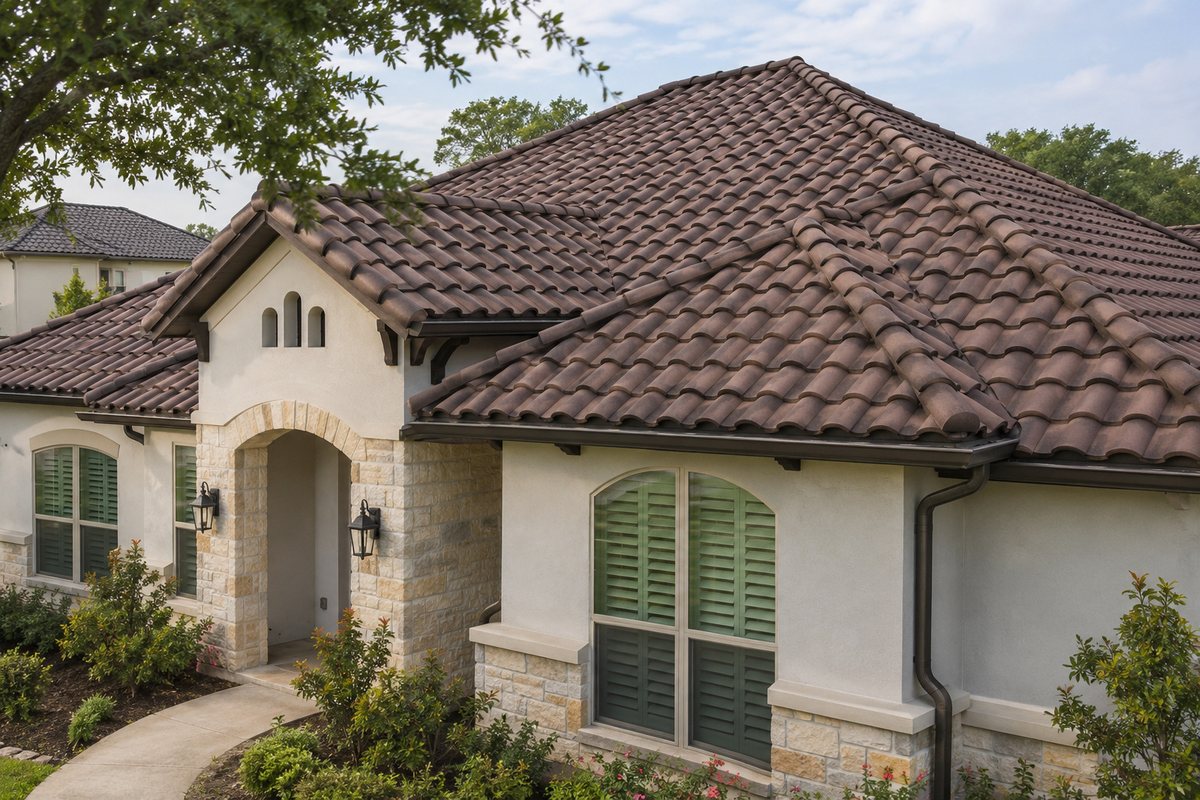
Clay tile. Fired clay keeps its color for decades because the color is in the material, not a coating. It comes in barrel (S-shaped or two-piece), flat and interlocking profiles.
Concrete tile. The most common tile in many Sun Belt subdivisions. Concrete tile comes in high, medium and low (flat) profiles and a wide range of colors, at a lower cost than clay.
Lightweight concrete tile. Made for re-roofs and homes that were not built to carry standard tile. It keeps the look of concrete tile at a lower weight.
Natural slate. Quarried stone split by hand into roofing slates, so every piece is a little different. It is non-combustible, keeps its color without coatings and needs very little maintenance. Slate is sorted by thickness and flatness, and good slate can outlast the building. Pre-assembled natural slate panel systems are also available; they are lighter, faster to install and don't need traditional slate experience.
Synthetic slate. Molded from polymers or composites to look like slate. It is much lighter, easier to cut and install, and often impact-rated.
Profiles and color
- High profile (barrel or S-tile): deep curves and strong shadows, the classic Spanish look.
- Medium profile: a softer wave, common on concrete tile.
- Low profile (flat): clean lines that suit modern and transitional homes, and the look of slate or shake.
Colors range from solid tones to blended and "variegated" mixes. On large roofs, tile from different production runs can differ slightly in color, so it's best to order the whole job at once.
Weight and structure
Tile and natural slate weigh more than shingles or metal. Before switching from a lighter roof, the roof framing should be checked by a qualified professional to confirm it can carry the load. For re-roofs of an existing tile roof, the structure was usually built for it. Where weight is a concern, options include thinner natural slate, pre-assembled natural slate panel systems, lightweight concrete tile, synthetic slate and stone-coated steel.
Installation basics
- Roof pitch: most tile needs a minimum pitch of about 2.5:12 to 4:12, depending on the profile and underlayment. Traditionally installed slate usually needs 4:12 or steeper; some natural slate systems are made for lower slopes.
- Underlayment: tile and slate are a water-shedding layer; the underlayment underneath is the waterproof layer. Heavy-duty or tile-rated underlayment is common, and in many areas a two-layer system is used.
- Battens: tile is often hung on wood battens, which help with drainage and airflow.
- Fastening: tile is fastened with nails, screws, clips, foam adhesive or a mix, depending on wind zone and local code.
- Trim and accessories: ridge and hip pieces, rake tiles, bird stops, eave closures and flashing complete the roof.
Tile and slate roofs should be installed by experienced crews. Always follow the manufacturer's installation guide and local code.
What to include in your quote request
- Tile or slate type, profile and color
- Roof size in squares, or plans or a roof measurement report
- Ridge, hip and rake lengths
- Underlayment, battens, fasteners or adhesive, and accessories needed
- New roof or re-roof, and job location
Related products
Common questions
Can I walk on a tile roof?
Carefully. Tile can crack under a point load. Step on the lower part of each tile, near the head lap, or use walk pads.
What happens when a tile breaks?
A single tile can be replaced without redoing the roof. Keeping a few spare tiles from the original order makes color matching easier.
Is the underlayment more important than the tile?
Both matter, but the underlayment is what keeps water out. On a tile re-roof, the underlayment is often replaced while good tiles are reused.
Natural or synthetic slate?
Natural slate is real stone: it lasts 100 years or more, is non-combustible and keeps its color. Synthetic slate is lighter and costs less up front but has a shorter service life. For a roof meant to last generations, natural slate is the benchmark.
Do you carry matching trim and accessories?
We supply trim and accessories for the tile and slate we quote. Tell us what you need in your quote request.