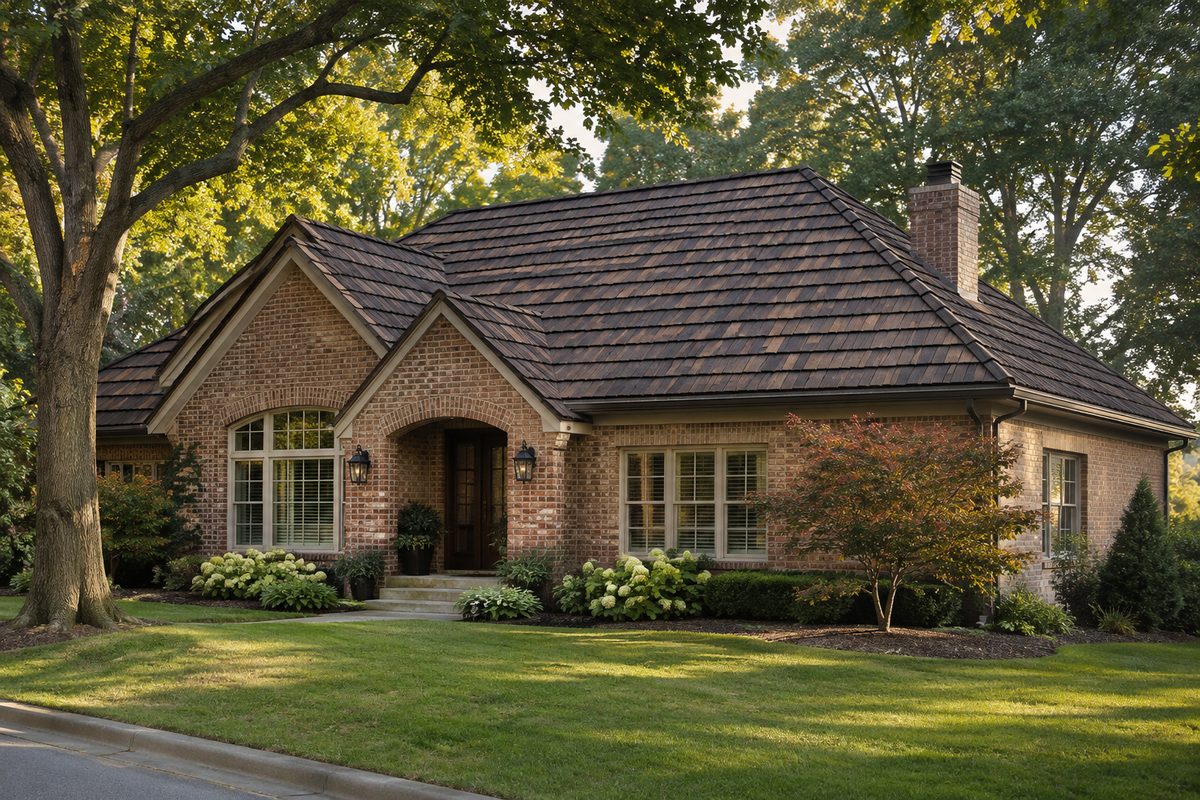

Profiles
| Profile | Looks like | Typical panels per SQ | Common uses |
|---|---|---|---|
| Shake | Thick wood shakes with deep shadow lines | About 25 to 29 panels per SQ | Homes, rustic and mountain styles |
| Shingle | Dimensional asphalt shingles | About 25 to 29 panels per SQ | Re-roofs, subdivisions, a familiar look |
| Barrel tile | Rounded clay or Spanish tile | About 25 to 29 panels per SQ | Mediterranean and Southwest homes |
| Flat tile | Low-profile concrete tile | About 25 to 29 panels per SQ | Modern and transitional homes |
| Slate | Natural slate with fine edges | About 25 to 29 panels per SQ | Traditional and high-end homes |
Panel sizes, coverage and colors vary by manufacturer. Your quote lists the exact specs.
Shake. The most textured profile. Deep, irregular shadow lines give the roof a hand-split look without the fire risk or upkeep of wood.
Shingle. Matches the look of a dimensional shingle roof, so it blends well in neighborhoods with mostly shingle roofs.
Barrel tile. Rounded profile that copies Spanish and Mission tile. A common choice where tile roofs are popular but a lighter roof is needed.
Flat tile and slate. Lower, cleaner profiles. Slate styles are thinner at the edge for a sharper, more formal look.
How the panels are made
Most stone-coated panels share the same basic layers:
- A steel core, usually 26 gauge, with a metallic aluminum-zinc coating for corrosion resistance
- An acrylic base coat that bonds to the steel
- Natural stone granules pressed into the base coat for color and texture
- A clear acrylic overglaze that locks the granules in place
The stone layer protects the paint from sun, softens the sound of rain and hail, and gives the roof its traditional texture.
Performance
- Weight: commonly about 125 to 150 lb per SQ, compared with roughly 900 to 1,200 lb per SQ for concrete tile. That is light enough for most framing built for shingles, and often light enough to go over one layer of existing shingles where code allows.
- Hail: many products carry a Class 4 impact rating, the highest rating under the standard hail test. Some insurers offer discounts for Class 4 roofs; check with your insurer.
- Wind: panels interlock on all four sides and are fastened to battens or the deck, which gives strong wind resistance.
- Fire: steel is non-combustible. Many systems reach a Class A fire rating when installed over the right underlayment.
Ratings vary by product and installation method. Ratings for the products you order are in your account.
Installation basics
- Battens or direct-to-deck: stone-coated panels are installed over wood battens (sometimes with counter-battens for airflow) or fastened straight to the deck, depending on the profile and the manufacturer.
- Roof pitch: most products need a minimum pitch of about 3:12. Some allow 2:12 with special underlayment.
- Underlayment: synthetic or self-adhered underlayment is used under the panels, with self-adhered membrane in valleys and around penetrations.
- Trim: each profile has matching ridge, hip, rake and eave pieces in the same stone finish. Order trim from the same product line so colors match.
- Re-roofs: some systems can go over one layer of existing shingles where local code allows.
Always follow the manufacturer's installation guide for the product you buy.
What to include in your quote request
- Profile and color
- Roof size in squares, or plans or a roof measurement report
- Ridge, hip and valley lengths
- Battens, underlayment, fasteners and touch-up materials needed
- Job location
Related products
Common questions
Is stone-coated steel noisy in the rain?
Less than many people expect. The stone layer and the airspace under the panels, especially on battens, dampen rain noise.
Will the granules come off?
Some loose granules are normal on a new roof. The overglaze holds the rest in place. A small touch-up kit covers cut edges and scuffs.
Can I walk on it?
Yes, with care. Step on the low points of each panel, near the batten or the front edge, as the manufacturer shows.
How does it compare with real tile?
It gives a similar look at a fraction of the weight, and steel won't crack the way clay or concrete can. Real tile has a longer history and a different feel; both are available through us.
How long does it last?
Commonly 40 to 50 years or more. Manufacturer warranties vary by product.